Search for lenses, articles and help
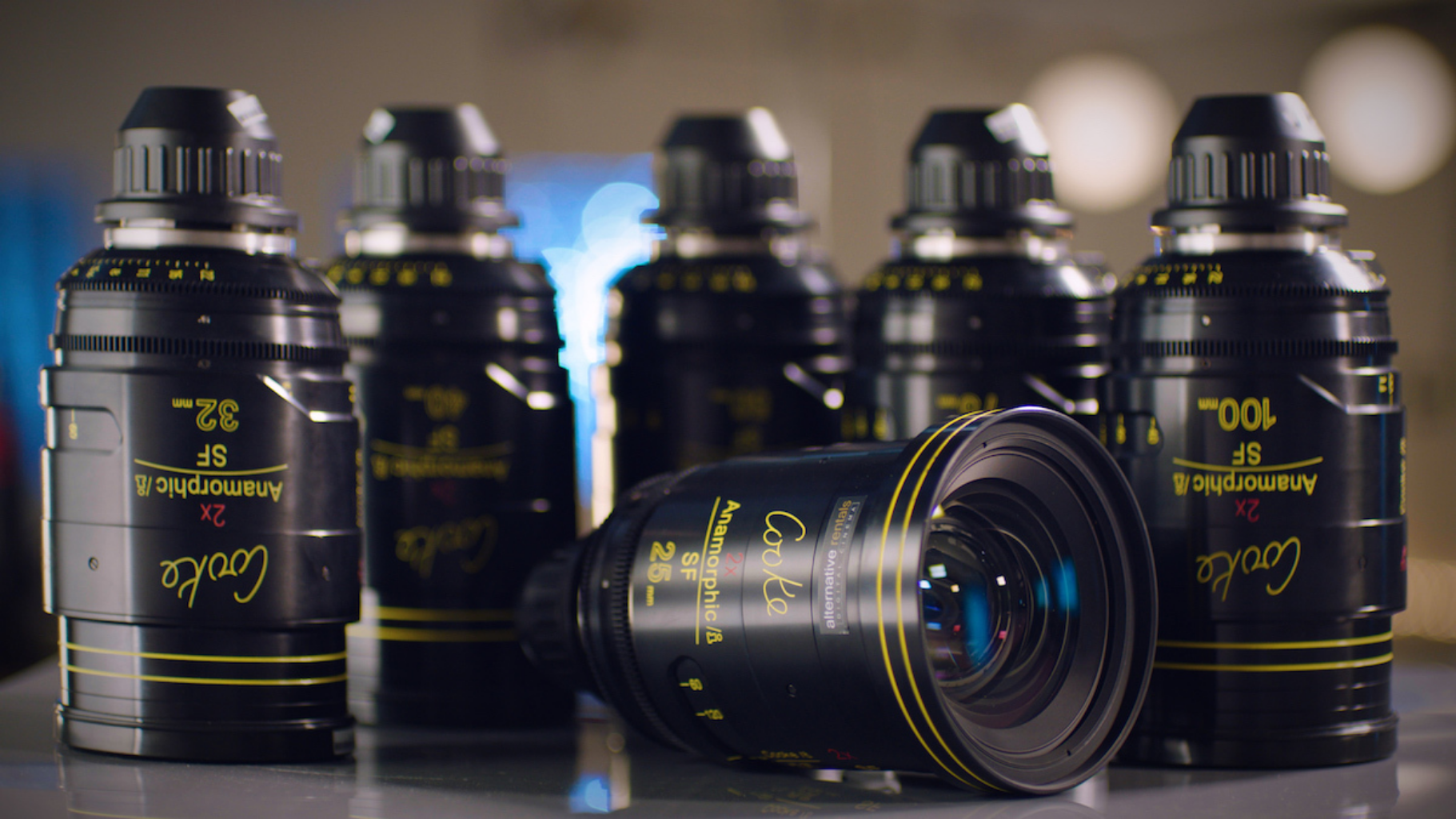
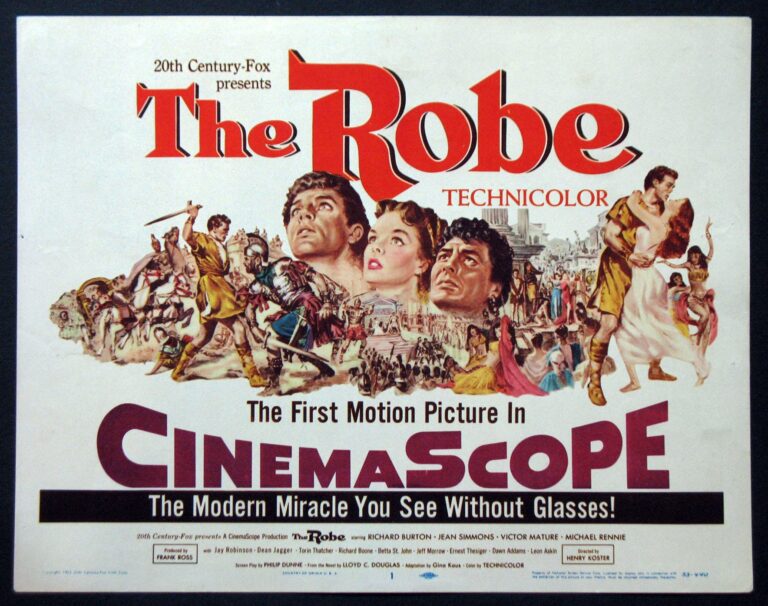
Choosing anamorphic lenses is rarely a neutral decision. The format carries seventy years of cinematic history with it: the widescreen epics of the 1950s, the golden age of Hollywood scope photography – decades of visual language that audiences have subconsciously absorbed. When a cinematographer reaches for anamorphic glass, they are making a deliberate choice to tap into that heritage and the specific optical characteristics that come with it.
But how to use the format in service of a specific story? The oval bokeh, the distinctive focus fall-off, the wider field of view relative to focal length: these are not just aesthetic signatures, they are creative tools with real narrative applications. The productions choosing anamorphic today are doing so with precise intentions: using the format’s characteristics to establish intimacy, distinguish between worlds, frame ensemble casts, or anchor visual effects in something organic and credible.
The following examples, drawn from productions shot on Cooke anamorphic lenses, illustrate how those intentions translate into practice across a wide range of genres and budgets.
One of the less immediately obvious opportunities of anamorphic lenses is physical; it changes where the camera needs to be in relation to the subject. Because the format delivers the horizontal field of view of a wider lens whilst retaining the focal length of a longer one, cinematographers end up working at a closer camera-to-subject distance than they would shooting spherically for an equivalent framing. That proximity has a direct impact on how an audience experiences a performance.
Pierre Gill CSC, who shot the pilot and final three episodes of Disney+’s ‘Percy Jackson and the Olympians’ on Cooke Anamorphic/i S35 lenses, was explicit about this being a primary motivation. “I am an anamorphic lover – the main reason is not always the artistic flare or bokeh, but the proximity to the actors. Anamorphic lets you be next to the face of the character – you are twice as close to an actor than you would be using spherical for the same size, and the audience feels it. Plus the dimensionality that anamorphic brings is very important.”
For a VFX-heavy production like Percy Jackson, that sense of physical presence and dimensionality is particularly valuable to ground performances against environments that are largely computer generated. Gill worked with four matching sets of lenses covering all focal lengths from 25mm to 300mm, ensuring a consistency across main unit, splinter unit and virtual production stages running simultaneously that would be hard to find had he used more vintage anamorphic lenses.
Paul Faltz, shooting horror mystery ‘Cuckoo’ on Kodak 35mm film stocks with Cooke Anamorphic/i S35 primes and the 35-140mm Anamorphic Zoom, found the proximity advantage particularly useful at the wider end of the focal range. “You can physically get super close to the characters with the camera without the actors’ faces getting distorted. The optics are full of character — you can feel the optical elements working in the image as the focus changes. All the things you want from vintage lenses, but with the advantage that these are modern lenses, with all the benefits they bring to the shooting process.”
‘Cuckoo’
The same quality informed cinematographer Manoj Sood’s decision to shoot Indian feature ‘Leo’ on Cooke Anamorphic/i FF lenses. Shooting full frame with a 1.8x squeeze, Sood found the pairing resolved three concerns that had previously made him reluctant to shoot anamorphic: skin tones, field of view and close focus. “Anamorphic gives a little more three-dimensional feel – the subject is isolated from the background and it gives a much more prominent feel. Without any filtration, I’m getting the softness I need and the little warmth on the skin is really pleasant.”
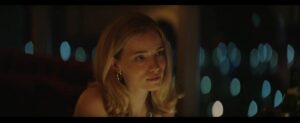
For cinematographer George Burt, shooting ‘Joe Baby’ on Cooke Anamorphic/i FF Special Flair lenses, the geometry of the format opened up compositional possibilities that spherical glass simply couldn’t match. “The 32mm is simply so wide – it’s incredible to go that wide with minimum distortion. A 32mm height with a horizontal field of view of under 18mm. It’s such an amazing extra width to image height.” His approach balanced the intimacy of wide lenses at close range with longer focal lengths for observational distance – using a 2x doubler on the 135mm and 180mm for extended tracking shots following his main character from afar.
‘Joe Baby’
Read the full ‘Percy Jackson and the Olympians’ case study / Read the full ‘Cuckoo’ case study / Read the full ‘Leo’ case study / Read the full ‘Joe Baby’ case study
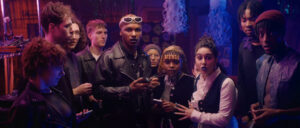
The wider aspect ratio of anamorphic photography has an immediate practical benefit for productions built around groups of characters. It creates more compositional room to hold multiple people in a single frame without the shot feeling crowded or the camera feeling forced to step back. In comedy, where timing and reactions between characters are fundamental to how a scene lands, this is not a trivial consideration.
Diana Olifirova’s approach to Channel 4’s ‘We Are Lady Parts’ established the creative case clearly: a wider frame to hold the whole band together, a format that felt fresh and distinctive in a genre not typically associated with scope photography. The punk energy of the show and the optical character of the Cooke Anamorphic/i S35 lenses proved to be a natural fit, with the soft edges at T2.8½ absorbed into the aesthetic rather than corrected against it.
‘We Are Lady Parts’
Tony Slater Ling BSC arrived at similar conclusions for BBC One’s ‘Am I Being Unreasonable?’, citing the 2.39 aspect ratio specifically as a tool for framing group shots and two-shot close-ups with a concentration on the characters rather than the space around them and heightening the visual storytelling of a series operating on a modest budget.
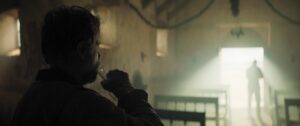
Paulo Perez ADFC’s work on Amazon Prime’s ‘La Cabeza de Joaquín Murrieta’ series was set against the wide landscapes of 19th century Mexico and demanded a format that could hold both the epic sweep of its environment and the complexity of its ensemble cast with equal conviction. Perez chose Cooke Anamorphic/i FF SF lenses and made an explicit argument to the production for shooting fully anamorphic. “I love the compositions you can achieve – not just of vistas but you can have three, four, five people in the frame talking to each other, framing in different layers. It’s so beautiful and cinematic. And if you need more choices, you only need two or three more shots, no more than that.”
‘La Cabeza de Joaquín Murrieta’
That last point is worth dwelling on. The efficiency argument for anamorphic in ensemble scenes is one that does not always make it into the conversation about the format’s creative merits – but for a production managing large casts across expansive locations, the ability to hold more within a single frame has real implications for scheduling and coverage. The creative and the practical, as is often the case with the best production decisions, support each other.
Read the full ‘We Are Lady Parts’ case study / Read the full ‘Am I Being Unreasonable?’ case study / Read the full ‘La Cabeza de Joaquín Murrieta’ case study
For much of its history, anamorphic and visual effects existed in an uneasy relationship. The optical characteristics that make the format so compelling – the distortion, the breathing and the distinctive aberrations – presented real challenges for VFX pipelines that were orientated towards more predictable and consistent lens behaviour. Matching CG elements to anamorphic photography convincingly required significant post-production effort, and the results were not always seamless.
That tension is beginning to dissipate – advances in lens metadata technology, VFX software and virtual production workflows have brought anamorphic and visual effects into a far more productive working relationship – one where the format’s characteristics can be replicated, matched and integrated with CG elements rather than worked around.
Cooke’s /i Technology has played a meaningful role in this shift. By capturing and transmitting precise lens data (focal length, focus distance, T-stop and distortion characteristics) frame by frame throughout a shoot, /i Technology gives VFX teams the information they need to match digital elements to the optical behaviour of the real-world lens with a level of accuracy that was previously unachievable without extensive on-set measurement and post-production guesswork.
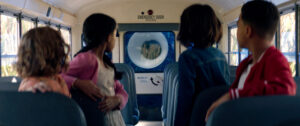
Cinematographer Megan Stacey’s work on ‘Sketch’, Seth Worley’s family adventure horror that premiered at TIFF 2024, demonstrates this. Shooting on Cooke Anamorphic/i S35 lenses, Stacey and VFX Supervisor Dan Sturm built the /i Technology metadata workflow into their production pipeline from the outset, using the lens data to inform how digital creatures and environments were composited against the anamorphic photography. The creative ambition of the project, a film explicitly designed to evoke the scale and wonder of early Spielberg, demanded that the VFX elements feel embedded in the world rather than layered over it. “The lenses were perfect for us,” Stacey noted, “they have all the modern luxuries of a new set of anamorphics but are designed with the softness, warmth and subtle distortion of an older set of lenses. There’s softness, there’s the traditional characteristics and there’s a little bit of breathing which is nice but it’s not totally mushy.”
‘Sketch’
At the other end of the scale, ‘Percy Jackson and the Olympians’ presented a more logistically complex version of the same challenge. With a VFX-heavy production requiring four matching lens sets covering focal lengths from 25mm to 300mm, consistency across multiple simultaneous units was as important as the quality of any individual lens. Cinematographer Pierre Gill CSC structured the production so that while the main unit was shooting on location, a separate crew was prepping with a matching lens package for the next virtual production stage. The workflow depended on the consistency of the Cooke Anamorphic/i S35 lenses across all four sets.
Volume shooting, using large LED screen environments to create location backdrops in a studio, presents its own specific considerations for anamorphic. The reflective surfaces of LED volumes can interact unpredictably with lens flare characteristics, and the controlled environment of a volume stage requires lenses that behave consistently and predictably enough to be trusted across extended periods of shooting. Glen Keenan CSC’s work on ‘Star Trek: Strange New Worlds’, using three sets of Cooke Anamorphic/i Full Frame Plus Special Flare lenses, speaks directly to this. Keenan’s aim was to use the lens characteristics to actively sell the illusion of real locations to the audience.
The broader point that emerges across these productions is that the characteristics once seen as obstacles to VFX integration have become assets. Now they make a composited image feel truer to life instead of constructed and give volume-shot environments a sense of physical credibility.
Read the full ‘Sketch’ case study / Read the full ‘Percy Jackson’ case study / Read the full ‘Star Trek: Strange New Worlds’ case study
The productions featured here span independent horror shot on 35mm film stock, large-scale streaming fantasy, low-budget British comedy and VFX-heavy virtual production. What they share is a deliberate choice to shoot anamorphic and a clear articulation of why that choice served the specific story they were telling.
That range is perhaps the most accurate measure of where anamorphic sits in contemporary filmmaking. It is not a format reserved for a particular scale of production or a particular kind of story. It is a set of optical tools that cinematographers are finding applications for across an increasingly broad range of contexts, budgets and genres.
What has not changed is the weight the format carries. The visual language established by seven decades of anamorphic cinema is embedded in how audiences experience the image, even when they cannot articulate why.
That is what makes the continued development of anamorphic lens technology worth paying attention to. The introduction of full frame anamorphic lenses and the integration of lens metadata into VFX workflows are not just incremental improvements, they are expansions of what the format can do and who can access it, without compromising the characteristics that filmmakers resonate with. The format has already earned its longevity but the work being made with it today assures that this legacy continues to grow.